Platform
Context Orchestration
The real AI advantage isn't generation. It's context infrastructure.
As companies scale, marketing context fragments—brand foundations in one place, initiative details elsewhere, product knowledge in massive docs. Even with AI, outputs drift because every asset is built on partial understanding. MarketCore's context orchestration treats context as systematic infrastructure: company truth that's always on, initiative context that's automatically applied, deep knowledge deliberately activated without diluting relevance.
Stop rebuilding understanding. Start with infrastructure.
Why flat context systems fail
No hierarchy → volume drowns strategy
Volume overwhelms strategy. When you dump 150 pages of product docs alongside a 2-page messaging framework, the AI can't distinguish strategic weight from sheer volume. Your positioning gets buried in technical noise.
No scoping → everything affects everything
Everything affects everything. You can't scope competitive intel to battle cards only, or keep product docs from contaminating marketing emails. Context you need for one content type pollutes everything else.
No portability → private work loses shared standards
Private work loses shared foundations. You can't combine personal drafts with team-approved brand standards. Your choice: full exposure or complete isolation. No layering possible.
MarketCore's layered context system solves all three—with hierarchy that preserves strategic weight, scoping that activates context deliberately, and portability that combines private work with shared foundations.
How MarketCore orchestrates context automatically
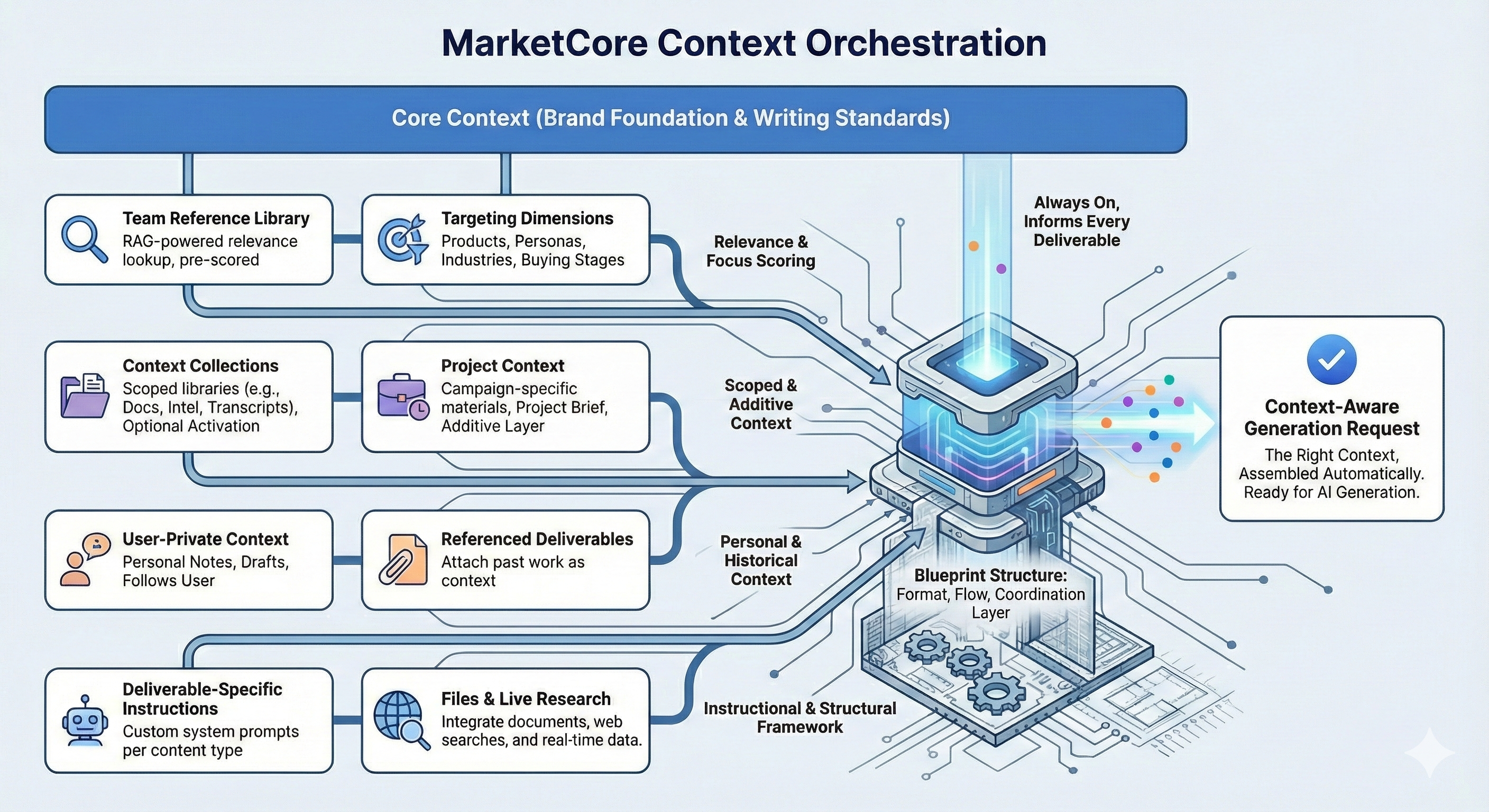
MarketCore's context orchestration system includes multiple intelligent layers that work together:
What you get in practice
Faster creation and better first drafts
When the system assembles context automatically:
- Setup time drops toward zero
- First drafts are more accurate, more on-voice, and less generic
- Editing time goes down because the model stops guessing
Consistency that compounds across the team
Context orchestration isn't just a productivity feature—it's an operating advantage:
- Junior marketers produce stronger work sooner
- Messaging stays consistent across people and projects
- Knowledge becomes reusable infrastructure (not tribal memory)
Deliverable-Aware Instructions Adapt Automatically
The system adapts based on what you're creating—no manual prompt engineering required.
When you create a sales battle card, the system automatically prioritizes competitive differentiation and objection handling. When you create a feature announcement, it emphasizes benefits and momentum language. When you create customer success content, it focuses on clarity and actionability.
- Sales enablement → scannable, objection-proof, value-focused
- Content marketing → storytelling, engagement, clear CTAs
- Customer success → clarity, practical examples, user empowerment
- Technical documentation → accuracy, completeness, structured detail
Context Collections: Scope What's Included
Not all context is relevant all the time. Activate specialized materials only when needed.
Context Collections let you organize specialized materials into optional libraries. Create collections for product documentation, competitive intelligence, customer call transcripts, legal materials, or archived content. Include them deliberately—not automatically.
- Product docs → Include for technical guides, exclude for high-level marketing
- Competitive intel → Include for battle cards, exclude for customer content
- Call transcripts → Include for customer stories, exclude for internal planning
- Legal/compliance → Include for regulated content, exclude for informal communications
Project Context Adds Campaign Intelligence
Campaign-specific intelligence without losing foundational context.
Project context is additive, not isolating. You get campaign-specific materials plus RAG-powered relevance lookup across your entire team reference library. The project brief automatically rides along with every deliverable you create within that project.
- Campaign messaging and positioning scoped to the initiative
- Initiative timelines, milestones, and constraints
- Launch materials and project-specific research
- Core brand voice and product truth still accessible via relevance
Reference Your Own Work as Context
Your best context often comes from content you've already created.
When creating a new deliverable, attach existing pieces from your library. The system treats them as reference context—understanding format, messaging, tone, and structure to inform the new piece.
- Maintain campaign consistency by referencing your launch announcement
- Adapt proven content by referencing a successful blog post for social variations
- Build content families with clear connections between related pieces
- Format adaptation from long-form to condensed versions
Live Research Integration Keeps Context Current
Even the best context library can't predict breaking news or market shifts.
MarketCore's Perplexity integration solves the "stale information" problem. Trigger live research on specific topics during content creation. The system pulls current information, displays it for your review, and includes it as context for generation.
- Current market conditions and competitive intelligence
- Industry trends and recent news incorporated in real-time
- Training data cutoffs don't limit content accuracy
- One-click promotion to save research findings to your Context Hub
Blueprints as Structural Context
Context isn't just what you say—it's how you structure it.
Blueprints capture the "how to build it" layer: format, flow, section structure, and coordination across multiple content pieces. Multi-format blueprints can even coordinate campaigns—a blog post, email highlights, and social posts—generated together with explicit relationships between formats.
- Reusable structure for consistent content types
- Format-specific optimization (subject lines, character limits, PDF layouts)
- Multi-format coordination (blog + email + social, all aligned)
- Campaign orchestration (launch plan + one-sheet + talk tracks as a package)
Learn more:See how Blueprints transform reusable templates into intelligent content frameworks
Ready to see context orchestration in action?
The best demo isn't watching copy get generated.
It's watching what MarketCore assembles before the first word is written.
Frequently Asked Questions
What is context orchestration (in plain English)?

It's a system that automatically gathers and prioritizes the business information an AI needs—brand voice, positioning, product truth, audience insight—so you don't have to paste it into every prompt. More importantly, it layers that context intelligently: foundational truth that's always on, specialized materials activated deliberately, and campaign-specific intelligence that's additive rather than isolating.
How is this different from a "knowledge base" or uploading documents?
A knowledge base stores information in a flat bucket. Context orchestration treats context as layered infrastructure—deciding what to use, when to use it, and how much weight it gets based on the deliverable type, target audience, and what you're trying to accomplish. It's the difference between a pile of files and a systematic foundation.
We already use ChatGPT/Claude. Why add MarketCore?
Generic AI tools—even with project features—use flat context pools where everything affects everything. You can't scope competitive intel to battle cards only, or keep product docs from overwhelming marketing emails. MarketCore's layered system gives you hierarchy (strategic messaging doesn't get buried), scoping (activate context deliberately), and portability (private work on top of shared foundations). The context you've built becomes genuinely reusable infrastructure, not just a bucket of files.
Will this help with messaging consistency across my team?
Yes. MarketCore keeps brand voice and strategic messaging always-on, so different teammates don't get different outputs simply because they remembered different context. Junior marketers can produce senior-level work because the system provides institutional knowledge automatically. And because context is layered systematically, everyone's working from the same foundational truth—even when adding campaign-specific or personal context.
